This page provides an overview of recent work and projects.
Report Reiko
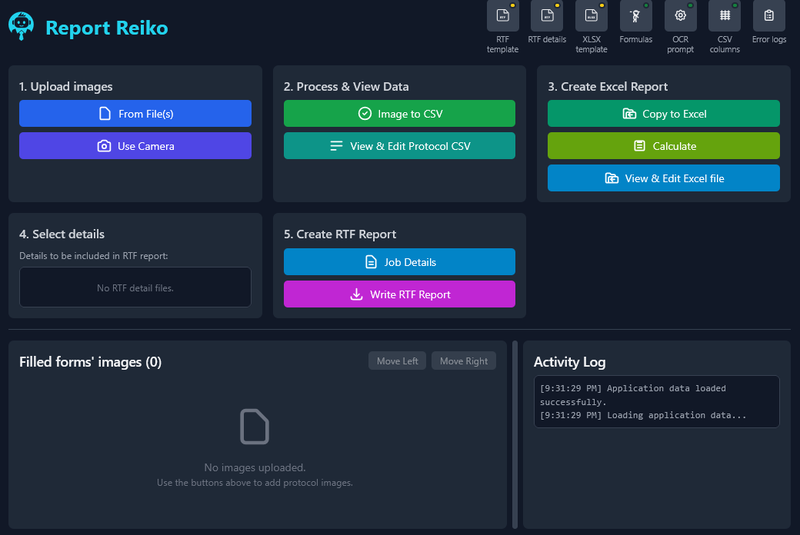
Report Reiko is a web application based a large multimodal model. Reiko takes your handwritten forms, converts these into 1) a table format (Excel file) and 2) written report (Word file), based on the structure and templates you provide.
LENA – Lecture Notes Annotator
LENA is a generative AI tool for transcribing audio recordings and text processing. It is configured to produce lecture notes, identifying the important parts of the lecture and compiling these into a logical structure.
ASKER – Attentive Spoken Knowledge Evaluator and Rebutter
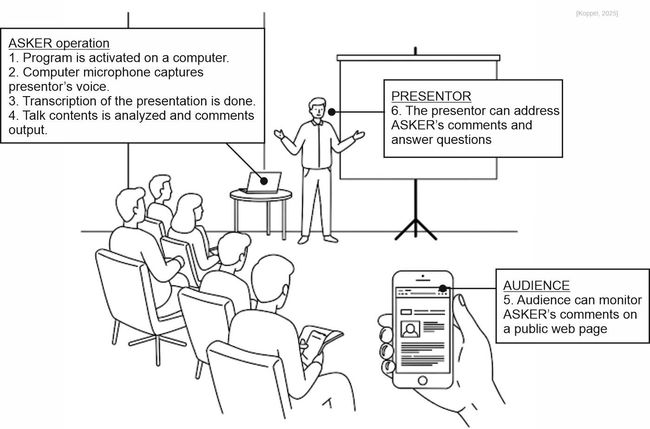
ASKER – Attentive Spoken Knowledge Evaluator and Rebutter, in Estonian – attentive spoken knowledge evaluator and rebutter. It is a generative artificial intelligence tool that listens to an oral presentation and forms an opinion based on a specified profile, for example through the perspective of a professor at a recognized business school. The tool listens to the presentation and provides feedback by assessing: 1) the relevance of the presentation, 2) commenting on shortcomings, and 3) asking questions. The output is updated every minute according to the information accumulated throughout the presentation. The computer program listens to and analyzes the content of the presentation. The public website displays ASKER opinions and comments.
REPLEI – Research Plan Evaluator and Improver
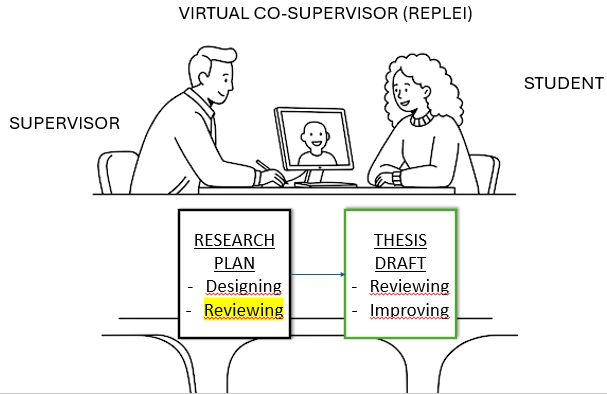
REPLEI is a generative AI tool for evaluating scientific research plans, identifying shortcomings and presenting suggestions for improvements. REPLEI provides instant feedback on clarity, structure, and coherence, ensuring that research aims, questions, and methods are well-defined and aligned with each other.
Read more at https://koppelai.eu/replei/
MiLDA – Military Leader Developer Assistant
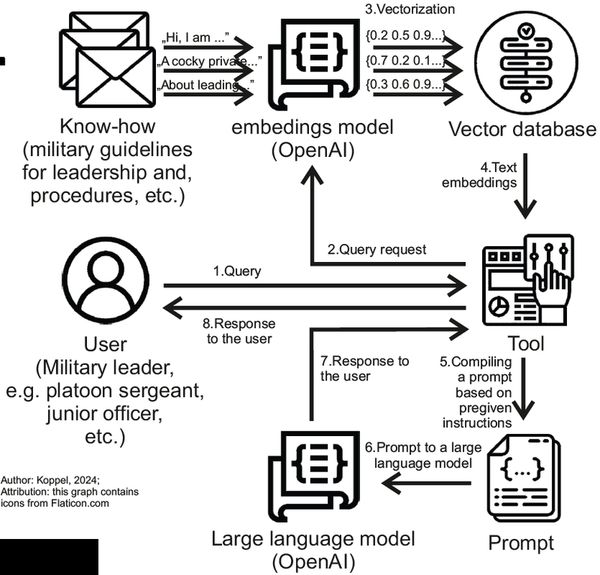
MiLDA is a virtual assistant (VA) based on the Large Language Model (LLM) designed to solve military leadership problems, primarily in the management of subordinates. MiLDA aims to 1) analyze challenging cases for leaders, 2) help them understand the situation from multiple perspectives, 3) propose solutions that are consistent with relevant military guidelines, and 4) provide general reflection. leaders in developing their leadership skills.
Skills
MiLDA’s capabilities include:
- Contextual Understanding
- Data Analysis
- Decision Support
- Interactive Dialogue and Guidance
- Ethical and Compliance-Conscious Recommendations
Target Users
- Sergeants and other non-commissioned officers (NCOs), including
- Squad leaders and other junior officers.
Case Resolution Method
MiLDA is designed to serve as a proficient problem-solving companion for military leaders, equipped with the abilities to navigate complex situations and facilitate efficient decision-making processes.
1. Case Assessment
Upon receiving a leadership case or scenario, MiLDA analyzes the presented information and evaluates it. It understands the nuances, variables, and potential challenges within the context, ensuring a comprehensive understanding of the situation.
2. Identifying Core Issues
MiLDA prioritizes critical issues within the case. It identifies the main problems, recognizes patterns, and highlights factors requiring immediate attention or supervision.
3. Applying Military Principles and Regulations
Using its extensive knowledge base, MiLDA aligns its analysis with established military principles, protocols, and guidelines. This ensures that the proposed solutions and insights are in line with military leadership ethos and best practices.
For more information, visit and try the demo at http://koppel.ee/milda/.
This was presented as a poster at the conference “ESTMIL – Military Technologies: Challenges for Small States,” held on January 24-25, 2024, in Tallinn.
Virtual Commissioner for Equal Treatment
The Virtual Commissioner for Equal Treatment is a virtual assistant based on the large language model, which has been assigned the role of an ‘equal treatment commissioner’. The latter is a statutory position in Estonia, whose office acts as a case handler for equality and equal treatment cases. The Virtual Commissioner’s task is to assess cases while remaining as closely as possible within the powers granted to the commissioner and interpreting situations within the framework of the law.

Skills
The Virtual Advocate’s capabilities include:
- Contextual Understanding of Complex Social Situations
- Identifying Individuals Involved in the Case and Discriminators and Discriminated Individuals
- Identifying Discriminatory Acts in the Case, Determining the Type of Discrimination, and Assessing the Severity Based on Legislation and Relevant EU Guidelines
- Interactive Dialogue, Including Guidance for the Discriminated or Case Handler
- Ethical and Legally Compliant Recommendations
Target Users
- Individuals suffering from discrimination, including both private individuals and public officials.
- Employers of individuals suffering from discrimination.
- Individuals handling discrimination cases.
Base Documents
The Virtual Advocate is primarily configured based on the following legal acts. These acts serve as the basis for responding to questions about the case from the perspective of Estonian legislation:
- Equality Commissioner and Secretariat Statute (adopted 10.06.2010 No. 71)
Link to the statute - Gender Equality Act (SoVS) (adopted 07.04.2004 RT I 2004, 27, 181)
Link to the act - Equal Treatment Act (VõrdKS) (adopted 11.12.2008 RT I 2008, 56, 315)
Link to the act
In addition to the above, the Virtual Advocate also considers the following documents in the second set, which include the discrimination categories, types, and definitions established in EU legal frameworks:
- European Union Charter of Fundamental Rights
- Racial Equality Directive (2000/43/EC)
- Employment Framework Directive (2000/78/EC) addressing workplace discrimination based on religion or beliefs, disability, age, or sexual orientation
- Directive on Equal Treatment in the Access to Goods and Services (2004/113/EC)
- Revised Gender Equality Directive (2006/54/EC) addressing equal opportunities and treatment for men and women in employment
- Directive (EU) 2019/1158 on work-life balance for parents and caregivers
- Horizontal Directive Proposal addressing discrimination outside the workplace based on age, disability, sexual orientation, and beliefs
- Proposal for a Transparency Directive on pay equality between men and women
Case Resolution Method
The Virtual Advocate follows these steps when providing opinions on cases:
- Document Preparation
The case is transcribed if there is an audio recording. If absent, the starting document consists of the parties’ statements detailing the sequence of events, actions, and statements. - Understanding the Scenario
The input data parameters include: location, individuals involved, scenario description, and transcription (if available). - Identification of Discriminators and Discriminated Individuals
Upon receiving the case, the Virtual Advocate analyzes the presented information and assesses it based on Estonian law (1st set). Considering input parameters and contextual nuances, the Virtual Advocate rates each individual on a scale of 0 to 1, indicating whether they experience discrimination and provides commentary on the situation. Similarly, it rates each individual on a scale of 0 to 1, indicating if they are discriminating against others and how. - Identification of Discrimination Category
- Direct Discrimination
- Indirect Discrimination
- Multiple and Intersectional Discrimination
- Harassment and Incitement to Discrimination
- Failure to Provide Special Measures by the Employer
- Hate Crime / Hate Speech
- Identification of Protected Grounds Violations
- Gender
- Transgender Identity or Expression
- Nationality
- Religion or Beliefs
- Disability
- Sexual Orientation
- Age
- Violation Identification According to Estonian Legislation
The Virtual Advocate lists any violations according to Estonian laws, presenting results in the phrasing of the relevant legislation. - Measures According to Estonian Legislation
If violations are identified, the next step is to propose the legal measures required by Estonian law for each violation, referencing the appropriate sections of the laws. - Providing Additional Recommendations
Beyond the measures required by law, the Virtual Advocate provides recommendations, such as actions that employers can take to prevent further discrimination.
This was presented at the Discrimination Information Day at Tallinn University of Technology on November 27, 2023.
IRA – Internal Representation Assistant
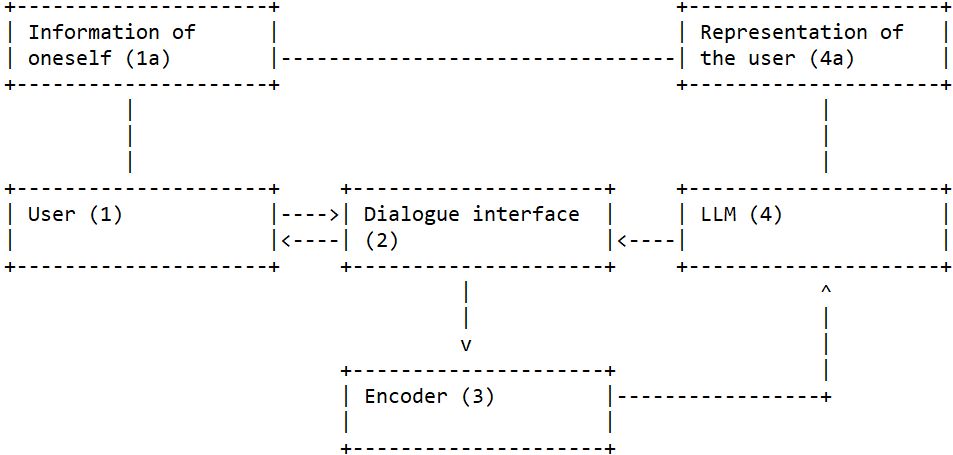
This assistant triggers the internal representation of the LLM user. This is an ongoing study that tests a virtual assistant architecture designed to bring out hidden knowledge that the LLM user has access to.
Background
When using LLM-based chatbots like ChatGPT, they often seem to know information about the user that has not been explicitly provided. For example, an LLM may understand the user’s demographic, political, religious, and other views – an internal representation of the user is formed within the LLM. It is not well understood how LLMs create such representations of users and what the source of this data is. It is known that LLMs suffer from hallucinations, where they sometimes generate text that the user did not expect. This can also be referred to as the alignment problem – the system does not function as intended. However, hallucinations can also be indicators of other unforeseen characteristics of LLMs.
Objectives
The goal of this study is to characterize the internal representation mechanism in an LLM when a representation of the user is formed within the LLM. The results of this study could potentially lead to the development of future LLM-based dialogue systems with a high level of understanding of their users.
Method
This study tests a system where the user interacts with the LLM through a special dialogue interface. Before sending input to the LLM, a multi-step encoder is used. The function of the encoder is to adjust the input information so that the formation of the user’s representation in the LLM can be detected and compared with the actual input information.
A/B testing is used in the system’s testing, so in some cases, the user communicates with the real system, and in other random cases, with a dummy system. A/B testing occurs under blind conditions, so the user is unaware when they are using the dummy system. The goal of the study is to collect enough experimental data to determine whether the real system provides statistically significantly (p > 0.05) more relevant and accurate information.
The demo model is not publicly available, but you may contact us if you wish to try the assistant and contribute to the study.