Lectures, workshops and professional trainings I do for business clients and others.
Identifying Training Needs
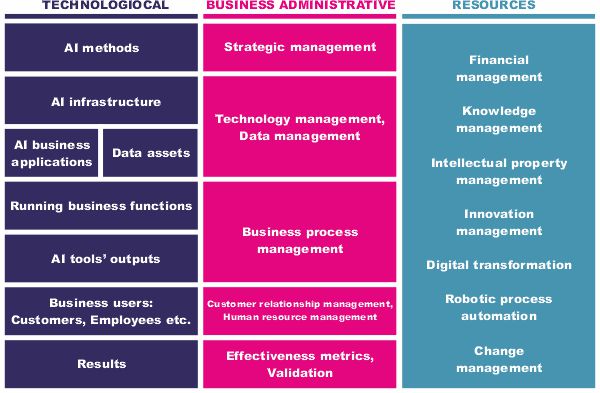
Figure 1 illustrates the three dimensions of business management—technological, business management, and resources. When a company plans to implement business artificial intelligence (AI), all these dimensions must be considered to ensure a successful launch. Below is a description of these dimensions.
Technological Dimension
The technological dimension encompasses the technical aspects related to the use of business AI, such as selecting technological platforms, data management and quality, algorithm development and training, automation, and system configuration. The company must decide which technological solutions best suit its needs and how they can be used for data analysis and business process automation.
Business Management Dimension
The business management dimension covers organizational aspects such as strategy, structure, processes, and personnel. The company must determine how AI adoption aligns with its business strategy, which processes can be automated, how to structure the organization to support AI implementation, and what training and resources are needed to ensure effective AI usage.
Resource Dimension
The resource dimension includes aspects such as project timelines and scheduling, required resources, and investments. The company must decide when and how to implement AI, define short-term and long-term objectives, and balance the costs and benefits of AI adoption.
Training Formats
Training sessions are generally available in four formats:
- Lecture – A 2-academic-hour (90-minute) session on a selected topic.
- Practical workshop – A 2-4 academic-hour session involving hands-on computer-based training, where participants acquire specific professional skills or practice performing business functions using AI tools.
- Training day – A full-day program lasting 6-8 academic hours, covering selected topics. A training day may include both lectures and practical exercises.
- Course – A program lasting 2-10 days, delivered either as an intensive course over a shorter period or as a regular course with one or two sessions per week.
Training sessions can be conducted in-person in a classroom setting or online via MS Teams or other platforms. We have unlimited access to MS Teams.
Location
Trainings can be arranged both on-site or online. On-site trainings can be held at the client’s location or at TalTech’s campus in Tallinn, Estonia. Depending on the group size, TalTech offers a comfortable classroom for 10 participants or an auditorium for up to 300 attendees.
Online support
The extent of online support depends on the training goals. Basic e-support includes access to training materials such as worksheets, guidelines, and reading materials. Upon request, the client may also opt for progress monitoring, submission of completed assignments, evaluations, and learner feedback through an online platform.
Topics
List 1 presents sample training topics and lecture themes by Tarmo Koppel, along with session durations in academic hours (45 minutes per session). Topics can be covered in greater depth upon request. Training sessions can be conducted in both Estonian and English.
List 1. Sample Training Topics and Lectures by Tarmo Koppel
History of AI (2-4 academic hours)
This lecture covers the development history of AI technology to understand how artificial intelligence has reached its current state. Historical turning points in industry. History of digitalization. We will review key enablers and foundational technologies of AI. We will look at the recent past, analyze technology trends to understand near-future directions, and establish longer-term visions. What should companies rely on when making long-term technology strategies?
AI Revolution (2 academic hours)
The AI revolution has begun—it is the fourth industrial revolution. We will examine parallels with previous industrial revolutions. We will learn to identify and analyze changes caused by the AI revolution in society and the economy, including business. By understanding historical parallels, we will learn to predict near-future developments to better adapt to changes in our personal career choices and business management. Waves of technological progress on “S-curves.” Limitations of AI implementation.
AI Fundamentals (2-6 academic hours)
Cognitive technologies extend the power of IT to tasks traditionally performed by humans. They can help organizations break the trade-offs between speed, cost, and quality. AI is a combination of different technologies that function more like the human mind compared to traditional computing. Algorithms mimic human thought processes and decision-making. AI vs. human intelligence. Technological singularity. AI calibers:
- Artificial Narrow Intelligence (ANI) – specialized intelligence
- Artificial General Intelligence (AGI) – human-like intelligence
- Artificial Superintelligence (ASI) – intelligence beyond human capability
AI application levels:
- Assisted Intelligence
- Augmented Intelligence
- Autonomous Intelligence
Subfields of AI. AI as a system: input, output, parameters. Key terms: enabling technologies, algorithms, machine learning models, programs, etc. Rule-based AI. Digitization vs. digitalization. Digital transformation.
Machine Learning Methods (2-6 academic hours)
Overview of machine learning methods. Machine learning algorithms as learning algorithms. The three main subfields of machine learning, depending on how the algorithm learns from data:
- Unsupervised learning
- Supervised learning
- Reinforcement learning
Supervised learning methods: classification and regression. Deep learning and artificial neural networks. Choosing the right algorithm. The most common approaches/algorithms. Building a machine learning model. Training data, validation data, and test data. Measuring model accuracy. Overfitting and underfitting.
Introduction to Business AI (2-4 academic hours)
The emergence of a new type of company—a data-driven enterprise. Why do businesses choose AI? To make strategic decisions regarding AI key technologies in a company, organizations must develop models that take into account specific needs and goals. This ensures AI technology is used in a way that aligns with overall business objectives. Why should companies focus on business opportunities rather than individual technologies when considering AI? Keeping pace with digitalization. Levels of AI empowerment in business. Process automation, data asset utilization. AI opportunities in business operations. Lessons learned from recent major changes.
Types of AI:
- By intelligence level
- By technology
- By interaction
- By purpose
- By method (algorithm)
- By business function
- By industry
Business AI Applications (2-6 academic hours)
Overview of AI applications in business. What problems can AI solve in companies? The main categories in which businesses apply AI solutions: process automation, data asset enhancement, virtual agents. AI applications across different industries. AI creates value for businesses in various sectors by improving processes, optimizing data, providing recommendations, and automating tasks. Examples of applied AI—what solutions is the technology currently capable of?
Predictive Analytics (2-6 academic hours)
Key methods in predictive analytics: classification, regression analysis, time-series forecasting. Predictive analytics is currently the most widely used AI technology in businesses—an estimated 60–80% of companies use it. Pattern recognition. Model accuracy evaluation, metrics. Code-free predictive analytics platforms and tools. Key considerations in predictive analytics business applications: accessibility, usability, speed, quality, scalability. Industry-specific tools vs. general-purpose tools. What types of data can be processed? What data should a company focus on?
Knowledge Graphs and Semantic Web (2 academic hours)
Ontologies as semantic data models. The main components of ontologies. Knowledge graphs combine characteristics of multiple data management paradigms: databases, graphs, and knowledge bases. Knowledge graphs for discovering and presenting relationships that would otherwise remain unnoticed in tabular databases. Enterprise Knowledge Graphs (EKG) use ontologies to create explicit conceptual models (schemas, taxonomies, vocabularies, etc.) that integrate with different enterprise systems. Resource Description Framework (RDF). Examples of knowledge graph types. Examples of large-scale knowledge graphs.
Foundations of the semantic web. The evolving vision of the semantic web.
Natural Language Processing (NLP) (2-4 academic hours)
Natural language processing (NLP) is a subfield of AI that helps computers understand written and spoken language as humans do. NLP enables language-related tasks to be performed on previously unimaginable scales. Text mining vs. NLP. How natural language processing works. NLP components: Natural Language Generation (NLG) and Natural Language Understanding (NLU). Stages of NLP. Common NLP tasks. NLP applications: idea generation, plagiarism detection, paraphrasing tools, grammar checkers. Text-to-speech, speech synthesis.
Commercial speech applications: the main business stakeholders and business processes involved in AI-based speech synthesis implementation.
NLP Applications in Marketing, Content Generation, and Content Analytics with AI (2-4 academic hours)
In the near future, AI-powered robots will meet the demand for unique and personalized content. Content marketing life cycles. Generating content using AI copywriters. Business text categories and marketing media:
- Copywriting
- Sales pitches
- Product descriptions
- Direct marketing emails
- Sales brochures
- Website content
- Tweets
- Marketing strategy adaptations
Previous Trainings
Below is an overview of the lectures, workshops, and other training formats I have previously conducted, along with their content.
Machine Assessment of Worker’s Productivity
Seminar Topics: Work ability assessment; Impact of technological advancements on work ability; Productivity and job performance; Work ability index (WAI) and its development; Factors influencing work ability; Cognitive and physiological indicators in work ability assessment; Stress measurement in the workplace; Machine learning and worker displacement; The importance of work ability in maintaining company competitiveness; Practical applications and future developments in work ability assessment.
Duration: 2 academic hours
Client: TalTech Business School
Target Audience: Researchers, lecturers, PhD students
Group size: ~30
Date: 30.09.2020
Location: Tallinn
Risks Related to New Technologies
Lecture Topics: Risks related to new technologies; Technological trends; Emerging technologies; Artificial intelligence (AI); Wireless connections; Safety management; Principles for reducing EMF exposure; Occupational EMFs directive 2013/35/EU; Employer action plan; Technical measures for risk reduction; Organizational measures for risk reduction; AI societal challenges; Ethical concerns in AI.
Duration: 2 academic hours
Client: University of Albany
Target Audience: University researchers, lecturers, students, and state officials
Group size: ~20
Date: 17.09.2021
Location: Albany (NY, USA)
New Disruptive Technologies 5G and AI, Their Societal Impact and Safety Aspects
Lecture Topics: Disruptive technologies; Technology Adoption Bell Curve; Artificial Intelligence (AI); Artificial Narrow Intelligence (ANI); Human intellect and AI; 5G wireless communications; Faster speeds in 5G; Higher bandwidth in 5G; Lower latency in 5G; 5G small cells; Beamforming in 5G; MIMO antennas in 5G.
Duration: 1 academic hour
Client: Collegium Ramazzini, Italy
Target Audience: Ramazzini Days 2022 participants
Group size:
Date: 27.10.2022
Location: Carpi (Italy) and online
Artificial Intelligence: Its Possibilities and Risks
Lecture Topics: Artificial Intelligence, its possibilities and risks; Digital revolution; AI revolution; Industrial revolution; Parallels between the industrial revolution and AI revolution; Complete AI revolution; Narrow AI (ANI); Predictions for the future of human labor; What is Artificial Intelligence; Machine learning model; AI business applications; Explainable AI in finance; Constraints in AI applications; Retrieve-then-read pipeline; LLM; Command-line examples; Types of prompts; Prompt structure; LLM writing code.
Duration: 1 academic hour
Client: Äripäeva Trainings
Target Audience: Business professionals at the Äripäeva internal control conference
Group size: ~120
Date: 30.03.2023
Location: Tallinn
Human-Centered Approach and Artificial Intelligence
Seminar Topics: Reliable, Safe & Trustworthy Systems; Cultures of Safety; Raising Trust through Oversight Structures; Principles of Reliable, Safe, Trustworthy Systems; Human-Centered Artificial Intelligence in Various AI Systems; Two-Dimensional Framework for Reliable, Safe & Trustworthy AI; AI Interlocks for Safety; Automation vs Augmentation in AI; AI Guidelines by IBM, Google, and Microsoft; Prometheus Principles for Human-AI Interaction; Examples of AI in Everyday Systems.
Duration: 2 academic hours
Client: University of Latvia
Target Audience: Summer school students and lecturers “Human Factors, Ergonomics, and Occupational Safety at Work”
Group size: ~25
Date: 23.05.2023
Location: Riga
Discrimination and AI
Lecture Content: Examples of cases where AI discriminates; AI helping in the analysis and resolution of discrimination cases; Reasons why AI discriminates. DEMO: Solving a sample case with Tarmo Koppel’s Equal Treatment Virtual Ombudsman.
Duration: 2 academic hours
Client: TalTech Business School ERS group
Target Audience: Corporate ethics, responsibility, and sustainability (ERS) enthusiasts
Group size: ~15
Date: 27.11.2023
Location: Tallinn
Advancements in Artificial Intelligence
Lecture Content: What is generative AI; Users of generative AI; Use cases of generative AI; What the future holds; Augmented worker; AI value creation.
Duration: 2 academic hours
Client: Robby&Bobby Accounting Office
Target Audience: Accounting office employees and clients
Group size: ~20
Date: 23.12.2023
Location: Online
Using Large Language Model-Based Virtual Assistants for Thesis Supervision
TalTech Business Faculty organized two practical seminars focusing on the possibilities of artificial intelligence and large language models in the thesis supervision process.
Seminar Topics: Large language model-based virtual assistants. Development of language models and automation of research work. Virtual supervisor’s role in various stages of thesis work. Checking thesis components and assessing their coherence. Using the virtual supervisor for editing drafts and providing feedback. Using virtual supervisor in thesis planning. Introduction to the “OpenAI Assistants API” platform. Advantages of the virtual supervisor: diverse perspectives, critique of research plans, correction suggestions. Creating a virtual supervisor without coding skills. Practical examples of configuring the virtual supervisor as a co-supervisor.
Duration: 5-6 academic hours
Client: TalTech Faculty of Business
Target Audience: Researchers and lecturers
Group size: ~20
Date: 8th and 15th May 2024
Location: Tallinn
Replacing Human Workers with Virtual Assistants – What Can Businesses Win or Lose
Seminar Topics: Conversational agents; virtual assistants/agents; virtual personal assistants; Replacing jobs due to AI; AI replacing jobs in the next 5 years; Wendy’s AI Order Taking ChatBot; Parallels of industrial revolutions; Dynamic technological change in industry; Augmented worker and AI-driven business transformation; Opportunities for digitizing companies with AI; Digitalization and AI solutions across sectors; Transforming business processes with AI; The future of work and AI’s impact on jobs; AI-based tools and their impact on business startups; AI integration with cyber-physical systems and multimodal systems; AI in legacy system integration; Domain-specific AI solutions for professionals (e.g., lawyers, doctors); AI-driven software automation solutions; Decision support software powered by AI; Future directions in AI development.
Duration: 5-6 academic hours
Client: University of Latvia
Target Audience: Students and lecturers at the summer school “Human Factors and Effective Business Management”
Group size: 15
Date: 3rd and 7th June 2024
Location: Riga
AI in Text Creation and Text Analysis
Training Content: Which AI to use? What types are available and what are their differences? How AI can help modern office workers, project managers, and program coordinators? How to feed data to AI to reduce human manual work? Work with legal acts. AI in text creation, image creation. Can AI converse and generate written text from conversation? Speech-to-text and summary creation. Can AI understand administrative procedures, administrative bodies, administrative decisions, etc.? AI assistance in generating letters, response letters, template letters, and conditions. How to use AI to create automated letters from existing data. In what areas can AI be smarter than humans? In what areas can AI never be smarter than humans?
Duration: 6 academic hours
Client: Civil Society Foundation
Target Audience: Civil servants, officials
Group size: 10
Date: 26.06.2024
Location: Paatsalu
Artificial Intelligence Implementation in Industrial Enterprises
The training provided an overview of AI tools that businesses can use in their daily operations, focusing on changes in the economy and business caused by the AI revolution. It covered groundbreaking technologies such as the Internet of Things in industry, digital decentralized solutions, and virtual assistants that improve business efficiency. The seminar also discussed virtual agents replacing human workers and the future division of labor between machines and humans. It included AI categories, business AI applications, business process optimization, data collection, real-time monitoring, analysis, and system integration, as well as decision-making systems and autonomous decisions.
Duration: 8 academic hours
Client: TalTech AI and Robotics Center AIRE
Target Audience: Entrepreneurs and business specialists from Virumaa
Group size: ~30
Date: 1st October 2024
Location: Rakvere
AI Opportunities in Car Sales
Training Topics: AI key concepts and fundamentals; AI implementation in business; IT-related risks for small and medium-sized enterprises; Analytical tools; Precision-targeted sales; Predicting consumer behavior; Digital customer acquisition tools; Legal aspects of AI implementation; Reducing administrative costs and time; Decision support systems; Fair and ethical AI; Human factors and secure AI.
Duration: 8 academic hours
Client: (Car sales sector business client)
Target Audience: Company employees
Group size: 8
Date: 14th November 2024
Location: Tallinn
AI Opportunities and Potential in Social Work
Training Topics: When is it safe to use ChatGPT; AI in social work – objectives; AI taxonomy in social work; AI applications in social work; Ethical aspects of AI in social work; Challenges of AI use in social work; Techniques for overcoming challenges; How to introduce AI to a social work service recipient; How to deal with resistance to AI usage; AI in data analysis in social work; Methodologies for social work data analysis using AI; Use cases of social work data analytics with AI.
Duration: 3 academic hours
Client: Estonian Association of Social Work (ESTA)
Target Audience: Social workers
Group size: ~150
Date: 11th December 2024
Location: Tallinn