Purpose: NETA is a generative AI tool for business negotiations that listens, analyzes, and provides tactical insights in real-time. It transcribes spoken dialogue, evaluates negotiation dynamics, and offers actionable recommendations, helping negotiators navigate discussions effectively.
Table 1. NETA overview
| Keywords | virtual assistant, negotiation assistant, LLM, semantic analysis, text summarization, topic modelling, knowledge extraction |
| Technologies/ Methods | speech to text (STT), automated speech recognition (ASR), natural language processing (NLP), large language model (LLM) |
| Platforms | OpenAI API; local machine |
| Programming language | Python |
| Models | speech to text model OpenAI Whisper large-v2, large language model GPT-4o |
| Supported input languages (audio recordings) | Afrikaans, Arabic, Armenian, Azerbaijani, Belarusian, Bosnian, Bulgarian, Catalan, Chinese, Croatian, Czech, Danish, Dutch, English, Estonian, Finnish, French, Galician, German, Greek, Hebrew, Hindi, Hungarian, Icelandic, Indonesian, Italian, Japanese, Kannada, Kazakh, Korean, Latvian, Lithuanian, Macedonian, Malay, Marathi, Maori, Nepali, Norwegian, Persian, Polish, Portuguese, Romanian, Russian, Serbian, Slovak, Slovenian, Spanish, Swahili, Swedish, Tagalog, Tamil, Thai, Turkish, Ukrainian, Urdu, Vietnamese, and Welsh. |
| Use case or business process | Business negotiation |
| Automated task | Dialogue notes taking and real-time analysis for insights |
| Input | 1. Audio (wav) in 30-sec chunks or when manually clicked by the user 2. Configuration documentation, including A) Context of negotiations B) General goals C) Possible outcomes classification D) Our position with supporting documentation E) Opposing team’s known position and collected materials |
| Transformation | Transcription, topic analysis, structuring, text summarization |
| Output | 1) Live feedback in user interface for system operator, 2) optionally live feedback on a closed access website (html) for team members |
| System operators/ application users | Business negotiators, consultants, advisors, executives |
| Output target (users) | (same as previous) |
Context
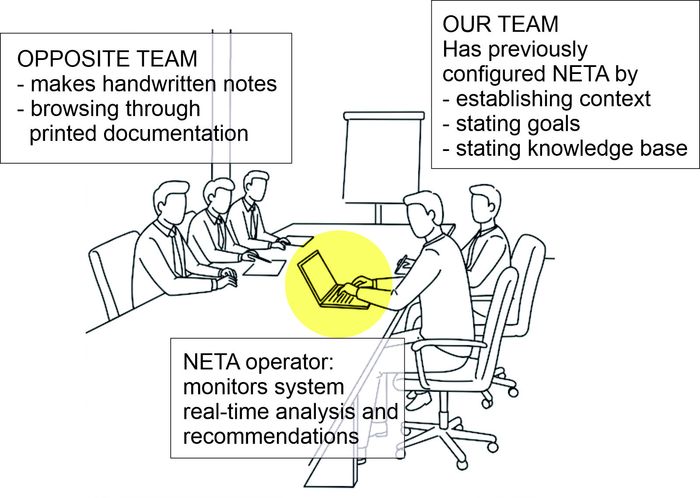
Figure 1. Context – The negotiations take place between two business teams that have researched each other’s positions and objectives. Both sides aim to establish a beneficial cooperation, with the specific terms and conditions being actively discussed (Graphics by Google Imagen 3)
Target users
The system is intended for the following target users:
- Business negotiators – Professionals engaged in discussions who need real-time strategic insights to strengthen their position and decision-making.
- Consultants and advisors – External experts supporting businesses in negotiations by leveraging insights to refine strategies and counterarguments.
- Executives – Senior leaders overseeing negotiations who require real-time assessments to make informed strategic choices.
Example application areas:
- Sales teams – Sales representatives negotiating contracts or partnerships who benefit from AI guidance on terms, objections, and deal structuring.
- Procurement specialists – Professionals responsible for supplier negotiations who use the system to assess risks, opportunities, and optimal terms.
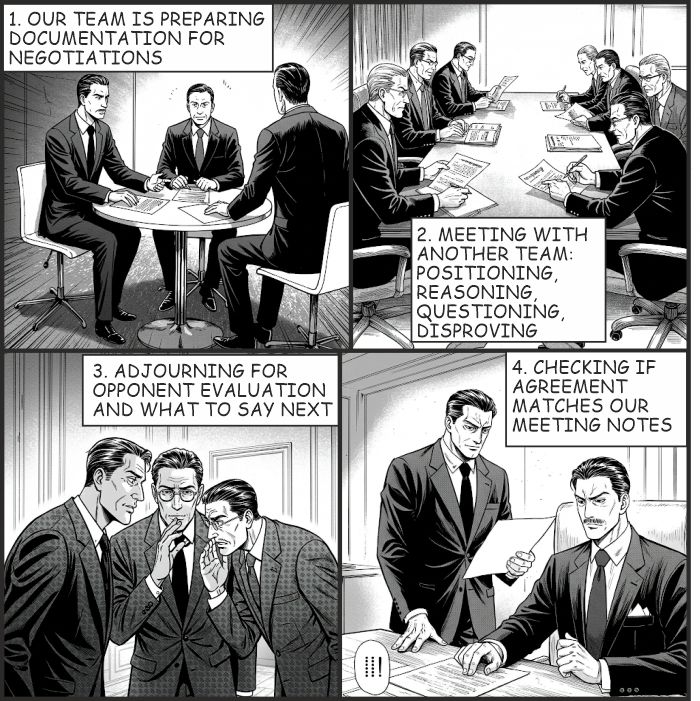
Traditional process
Automated process

Automation
This is an automated tool for business negotiation support that would replace or enhance the role of a tactical advisor by:
- Processing the negotiation audio and transcribing it into structured text.
- Analyzing the conversation in real time to identify key challenges, opportunities, and the overall strength of our team’s position.
- Extracting critical discussion points and assessing negotiation dynamics to provide tactical advice.
- Generating recommended responses and action plans instantly, reducing the time and effort required for manual note-taking and decision-making.
System architecture
User Interaction
- The User initiates the process by uploading an audio file containing a lecture.
- Through the User Interface, the user can configure settings and initiate the transcription and analysis processes.
- The processed lecture notes are eventually returned to the user.
Transcription Process
- The audio file is sent to the Transcription Model, which converts the spoken lecture into a text transcript.
- This transcript is stored in the Storage Module for further processing.
Analysis Module
- The transcript and lecture notes flow into the Analysis Module, which processes the text to extract key concepts.
- This module also facilitates system configuration and sends system commands for managing the workflow.
Fact-Checking Module
- The Fact Check Module ensures the accuracy of the lecture notes by verifying them against reliable sources.
- This module processes the lecture notes and refines them for accuracy and coherence.
Large Language Model (LLM)
- The Large Language Model (LLM) assists in concept mining, helping to extract relevant terms and insights from the lecture transcript.
- It sends processed concepts and refined lecture notes back to the Storage Module and the Analysis Module for further refinement.
Storage Module
- Acts as a central repository where transcripts, concepts, and lecture notes are stored.
- The stored information is utilized by the Analysis Module and Fact Check Module to enhance lecture notes’ accuracy and relevance.
Final Output after the meeting presents the last best version of AI recommendations to our negotiation team.
Configuration
The system is configured before negotiations to ensure it operates with a clear understanding of the context, objectives, and strategic parameters. The key configuration elements include:
A. Context of Negotiations
- Defines the subject matter of the negotiation, such as contract terms, partnership agreements, pricing structures, or dispute resolutions.
- Establishes the background, history, and relevance of the negotiation.
- Identifies the stakeholders and their interests.
B. Our General Goals
- Specifies the overarching objectives the team aims to achieve, such as securing a favorable contract, maximizing profitability, or establishing long-term cooperation.
- Defines measurable success criteria to guide the negotiation process.
C. Possible Outcomes Classification
- We set potential negotiation results into three predefined levels:
- A – Best Achievable Outcome: The most favorable deal that fulfills all strategic objectives.
- B – Satisfactory Outcome: A compromise that meets essential requirements and remains acceptable.
- F – Unacceptable Outcome: Conditions that do not align with business goals, making the deal non-viable.
- Helps the system assess real-time progress and alert the team when discussions move toward undesirable territory.
D. Our Position with Supporting Documentation
- Uploads internal reports, market analyses, financial assessments, and legal documents to reinforce the negotiation stance.
- Ensures the system references factual data to support arguments and counterclaims.
- Enables to refer to specific evidence for stronger persuasion.
E. Opposing Team’s Known Position and Collected Materials
- Compiles available intelligence on the opposing team’s strategy, priorities, and potential constraints.
- Integrates prior communications, press statements, financial reports, or industry insights to anticipate their moves.
- Enables the system to identify alignment or conflicts between both parties and suggest strategic adjustments.
System operation and functionality
1. CAPTURING AUDIO
At the start of negotiations my team activates the assistant and put it into listening mode. Audio is stored in 30-sec sessions (wav-files). System operator can also manually stop the session, e.g. when AI insights are needed urgently.
2. Transcription
The system converts spoken language into text through an automated transcription process. Two modes of transcription are implemented:
- Transcribe to Original Language: The input audio is processed using an ASR model, preserving the original language.
- Transcribe and Translate to English: The ASR model transcribes the audio, and an additional NLP module translates the output into English.
The resulting transcript text (txt) files serve as the foundational dataset for subsequent processing.
3. Transcript Compilation
Following transcription, the system compiles all previously transcribed segments into a single text document, preserving the original sequence of speech. The transcript file is constantly updated by adding latest 30 sec chunks, hence further analysis is always conducted on the whole transcription text.
4. Information Extraction and Analysis
The system employs LLM models to extract key informational components and to conducts text analysis. These components are listed below in section “System output”.
Log file – The tool stores all previous outputs for future reference.
5. Visual Representation
To improve text understanding and offer further insights, the system generates graphical representations of extracted information:
- Problem trees: An AI-powered diagram generation module visualizes problems by building an association tree for depicting a) Opposite team’s weaknesses, B) Out team’s challenges.
- Opportunities mind map: Helps to grasp the associations between the identified opportunities.
- Our position mind map: Combines our statements and limitations into graphical representation of associations.
6. TEXTUAL REPRESENTATION
The system consolidates all processed information into a structured output displayed on the screen of the user interface. Optionally, the system can also display output on a password protected website, accessible to our team members.
Fact-Checking (Optional): A verification module employs LLM to cross-check extracted information, ensuring accuracy and reliability.
7. FINALIZATION
When the meeting is ended, the system operator hits the STOP button, whics ends monitoring mode, and finishes the last audio chunk, conducts transcription and provides final output.
8. Archiving and Cleanup
The final stage involves organizing output data and deleting temporary files. The compiled text document is are archived in a dedicated directory. Intermediary information extraction steps outputs (wav- and txt-files) are deleted.
System output
Metadata
Date and time, Location, List of companies, List of participants, Meeting title
A. OPPOSITE TEAM’S WEAKNESSES
This section highlights vulnerabilities or disadvantages in the opposing team’s position, as identified by the system’s analysis of their statements, hesitations, and inconsistencies. These weaknesses may include unclear strategic direction, internal disagreements, budget constraints, or dependency on specific deal conditions. By recognizing these factors, the system helps negotiators adjust their strategy to maximize leverage.
B. OUR TEAM’S CHALLENGES
This section identifies key obstacles encountered during negotiations. Recognizes challenges based on predefined parameters such as pricing conflicts, legal concerns, or strategic misalignment. The system continuously analyzes conversation dynamics and recognizes challenges based on predefined parameters such as pricing conflicts, legal concerns, or strategic misalignment. By highlighting these roadblocks in real time, the system enables the team to address them proactively.
C. OPPORTUNITIES WE COULD PURSUE
The system evaluates negotiation discourse to identify potential advantages. These opportunities may include new collaboration possibilities, areas for compromise that still meet objectives, or additional value propositions that can strengthen the team’s position. By surfacing these insights, the system assists negotiators in leveraging favorable conditions.
D. OUR POSITION (1…5)
This section consolidates the team’s stance, incorporating pre-defined goals, supporting documentation, and evolving discussion points. The system continuously assesses whether the negotiation is aligning with the desired outcomes and provides an objective assessment of the team’s standing based on real-time analysis. For each of our goals, a numeric assessment is given in Likert’s scale 1-weak … 5-strong together with an explanation.
E. SUGGESTED ACTION
The system generates strategic response suggestions based on the negotiation flow. It considers historical data, context, and the opposing team’s statements to recommend well-structured replies that align with the team’s objectives. These responses help negotiators maintain control, counter objections effectively, and steer the discussion toward mutually beneficial agreements.
Output example
(COMING)